Agentic AI Bootcamp
A practical, intensive 3-day hands-on bootcamp covering Agentic AI that takes you from first principles to a fully working, self-built autonomous AI agent. You will learn core agentic AI concepts and architectures, work with leading open-source tooling, host and fine-tune …

Overview
A practical, intensive 3-day hands-on bootcamp covering Agentic AI that takes you from first principles to a fully working, self-built autonomous AI agent.
You will learn core agentic AI concepts and architectures, work with leading open-source tooling, host and fine-tune models locally, equip agents with memory and custom skills, orchestrate multi-agent systems, and apply essential security defenses — including protection against prompt injection.
By the end of the bootcamp, you will have designed, trained, secured, and demonstrated your own locally hosted agentic assistant.
What You’ll Build in 3 Days
- Day 1: Your first ReAct agent — a tool-using Q&A agent powered by an open-source model, complete with a visible reasoning trace.
- Day 2: A locally hosted open-source model (via Ollama), custom skills/tools for your agent, a RAG knowledge skill using a vector database, and a small model fine-tuned with LoRA on a custom dataset.
- Day 3: A two-agent pipeline (planner + worker), an indirect prompt-injection attack on your own agent, and a practical defense against it.
- Capstone: A complete, locally-hosted agentic assistant that combines custom skills, memory/RAG, and at least one prompt-injection defense — presented live to the group.
Tools & Platforms You’ll Master
- Local Model Hosting: Ollama (pulling models, Modelfiles, quantization)
- Hugging Face Ecosystem: Model Hub, Transformers, PEFT / TRL
- Agent Frameworks: LangChain, LangGraph, CrewAI, AutoGen
- Memory & RAG: ChromaDB (vector memory)
- UI Prototyping: Gradio / Streamlit
- Fine-tuning Techniques: LoRA, QLoRA, instruction datasets
- Open-source Models: Llama, Mistral, Qwen, Phi and other agent-friendly models
Day-by-Day Curriculum
DAY 1: Foundations of Agentic AI
Understanding what agentic AI is, how it differs from a chatbot, and building your first agent.
Topics Covered
- What is Agentic AI — autonomy, tool use, goal-directed reasoning
- Agentic AI vs. traditional chatbots / LLM apps
- Types of Agentic AI: reflex, model-based, goal/planning-based, utility-based, learning agents
- ReAct agents (Reason + Act) and reflection agents
- Single-agent vs. multi-agent systems — overview
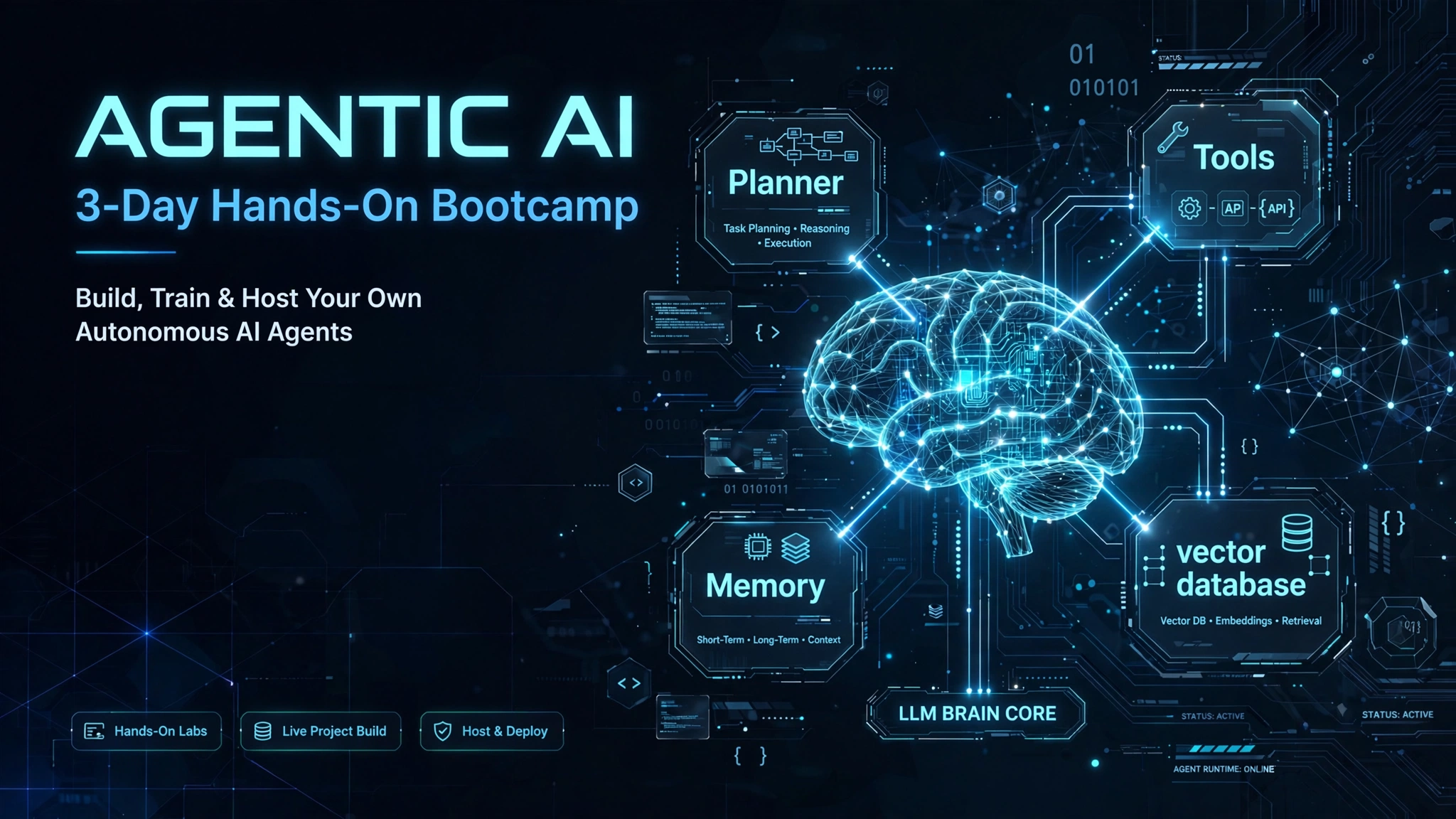
- Anatomy of an agent: LLM, memory, tools, planner/orchestrator
- Introduction to agent frameworks: LangChain, LangGraph
- Overview of open-source models suited for agentic tasks (Llama, Mistral, Qwen, Phi)
Hands-on Demo: Build your first ReAct agent — a tool-using Q&A agent powered by an open-source model, with a visible reasoning trace.
Challenges Discussed
- Hallucinated or incorrect tool calls
- Infinite reasoning loops and latency/cost of multi-step agents
DAY 2: Building, Training & Hosting Your Agent
Hosting open-source models locally, giving your agent skills, and fine-tuning your own model.
Topics Covered
- Hosting open-source LLMs locally with Ollama — pulling models, Modelfiles, quantization
- The Hugging Face ecosystem — Model Hub, Transformers, choosing a model for agentic use
- Giving your agent skills — custom tool/function creation, plugin-style skill registries
- Retrieval-Augmented Generation (RAG) as a knowledge skill using a vector database
- Training / fine-tuning your agent’s model — when to fine-tune vs. prompt vs. RAG
- Fine-tuning fundamentals: instruction datasets, LoRA and QLoRA, PEFT
- Exporting and hosting a fine-tuned model locally
Hands-on Demo: Host an open-source model locally via Ollama, add custom skills to your agent, and fine-tune a small model with LoRA on a custom dataset.
Challenges Discussed
- GPU/VRAM limits and quantization trade-offs
- Fine-tuning dataset quality and catastrophic forgetting
DAY 3: Multi-Agent Systems & Agentic AI Security
Orchestrating multiple agents, understanding prompt injection, and securing your agent — capped by a capstone build.
Topics Covered
- Multi-agent architectures: supervisor–worker, planner–executor, debate/critic patterns
- Agent memory at scale — short-term vs. long-term, memory drift and hallucination
- Prompt injection fundamentals — direct vs. indirect injection, tool-poisoning, excessive agency
- Mapping to the OWASP Top 10 for LLM Applications
- Defenses and guardrails — least-privilege tool scoping, human-in-the-loop, input/output filtering, sandboxing
- Deploying and demoing a finished agentic application
Hands-on Demo: Build a two-agent pipeline (planner + worker), then attack your own agent with an indirect prompt-injection payload and apply a defense against it.
Challenges Discussed
- Agent hijacking via indirect prompt injection
- Balancing autonomy with safety and control
Capstone Project
- A locally-hosted agentic assistant combining custom skills, memory/RAG, and at least one prompt-injection defense — presented live to the group
FAQs
Requirements
- 32GB+ RAM laptop
- Basic Python
- Free Hugging Face account (you can create one during the session if needed)
- No prior experience with agent frameworks or fine-tuning is required — we start from the fundamentals and build everything hands-on.
Target audiences
- Software developers and engineers who want to move beyond basic LLM apps
- AI/ML practitioners looking to build real autonomous agents
- Technical product managers and founders exploring agentic systems
- Anyone with basic Python knowledge who wants hands-on experience with modern agent frameworks, local model hosting, fine-tuning, and agent security
- Cybersecurity Experts, Digital Forensics Analysts
- Chief Information Security Officers (CISOs)
- Cybersecurity professionals and AI/ML engineers
- Anyone responsible for safeguarding AI-enabled systems
You May Like

Certified AI Program Manager (CAIPM)
CyberFox Train presents C|AIPM — Certified AI Program Manager from EC-Council. The certification for professionals who own AI decisions and drive enterprise execution
Certified Data Centre Environmental Sustainability Specialist (CDESS)
Become a Certified Data Centre Environmental Sustainability Specialist (CDESS) and lead the way in eco-friendly data center operations. Master green energy solutions, carbon footprint reduction,...

AI Cyber Defender
Master the integration of AI into cybersecurity strategies with our AI in Cybersecurity Training. Hands-on training and expert guidance provided.
DORA Lead Manager
Gain the expertise to lead digital operational resilience strategies and ensure compliance with the European Union’s DORA for financial entities with the PECB Certified DORA...
Certified Cyber Threat Analyst (CCTA)
Master the skills to detect, analyze, and mitigate cyber threats with the Certified Cyber Threat Analyst (CCTA) Training Course at Cyberfox Train. Enhance your threat...
Course Features
- Lecture 0
- Quiz 0
- Duration 3 days
- Skill level Intermediate
- Language English
- Students 30
- Assessments Yes